Sourcing guide
Landed Cost per Japanese Pokémon Booster Box with a Quote Worksheet
At a glance
Compare both quotes at your shop door, in one currency. Add buyer-paid shipping and fees outside the quote, subtract confirmed recoverable tax already counted, and divide by sellable boxes. In this example the cheaper quote wins at 24 sellable boxes, then loses if one box fails inspection.
Ask both suppliers to quote the same order
Send both suppliers the same request for twenty-four sealed Japanese booster boxes. Give the set name and code, specify Japanese-language stock, and describe the condition your shop can sell. State whether you accept dents or tears in the outer wrap and whether the boxes need to arrive in a factory-sealed case. Include the full shop address and the date range in which you can receive the order.
Ask each supplier to confirm the quantity they can commit to and the expected dispatch and arrival dates. If they quote packs or cases, ask them to restate the offer in sealed booster boxes and confirm how many boxes each case contains. If a supplier can fill only part of the order, record the shortfall and price the remaining boxes before comparing that offer with a full allocation.
Write down the box condition used for the comparison. A dented box might still sell at a discount, but it belongs outside the count for a full-price sealed-box order. Use the same rule for both suppliers, and keep any real credit or resale proceeds separate until the amount is known.
Find where each supplier’s delivery ends
Under Delivered at Place, or DAP, the buyer handles import clearance. Under Delivered Duty Paid, or DDP, the seller handles it. The named place determines where delivery occurs and risk transfers under the term. In this comparison, Supplier A names a cargo terminal and Supplier B names the shop address. Budget the terminal-to-shop leg for A and confirm that B has quoted delivery to the full shop address.
Ask for written confirmation of who pays for import clearance, customs charges, terminal handling, insurance and final delivery. For A, get a price for pickup and local delivery on the same schedule you gave B. For B, check that import clearance and delivery to the full shop address are in the quote. Use zero for a charge only after confirming your shop owes nothing. Mark a charge you have yet to price as pending and see whether it can change the decision.
Turn the quote into cost per sellable box
Use one store currency throughout. Record the exchange rate as units of quote currency per unit of store currency, then divide the invoice amount by that rate. For a yen quote, JPY 150 per USD means JPY 240,000 ÷ 150 = USD 1,600. Save the rate source and date with the estimate. Use the rate your payment provider actually applies when you settle the invoice. Add separately billed payment fees once, keeping any fees already reflected in the rate out of that line.
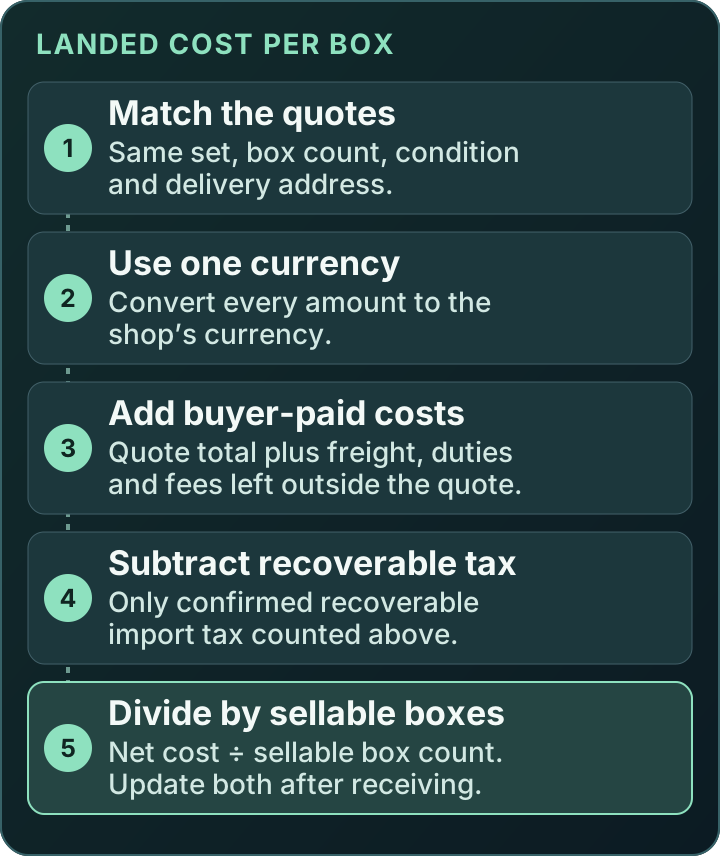
Gross cash outlay equals the converted quote plus uncovered costs your shop pays to receive the goods. Net landed cost equals that cash outlay less confirmed recoverable import tax already counted in it. Divide net landed cost by the number of boxes that meet your sellable condition. Before ordering, use an expected sellable count. After receiving, use the inspected count. If every box fails inspection, record the total batch cost and leave the cost per box blank.
For a separate illustration, suppose your shop pays USD 40 of import tax that was outside the quote and confirms it can recover the whole amount. That payment adds USD 40 to upfront cash outlay. The confirmed recovery offsets that same USD 40 in net cost. If recovery is pending, keep it out of the deduction until confirmed. Seller-paid charges already included in a delivered quote stay in that quote, and recovery depends on your own records and eligibility.
The calculation in three lines
Gross cash outlay = converted quote + buyer-paid costs outside the quote
Net landed cost = gross cash outlay − confirmed recoverable tax already counted
Cost per sellable box = net landed cost ÷ sellable boxes
Compare two quotes for the same 24 boxes
This is a hypothetical purchase of the same 24 Japanese booster boxes in the same condition, for the same store and receiving window. Both suppliers quote in yen. The store models both payments at JPY 150 per USD. A delivers to a named cargo terminal and the buyer arranges the last leg. B delivers to the shop and covers import clearance and duty. Neither offer includes the buyer’s separate payment fee, and the example assumes no recoverable import tax.
Once both offers reach the shop door, A’s USD 200 advantage on the converted quote narrows to USD 30 on the landed total. If all 24 boxes pass inspection in both offers, A costs USD 74.17 per sellable box and B costs USD 75.42. Confirm the local delivery and import bill before making that call.
| Cost or quantity | Supplier A | Supplier B |
|---|---|---|
| Delivery term and named place | DAP to cargo terminal | DDP to shop address |
| Boxes ordered | 24 | 24 |
| Supplier quote | JPY 240,000 | JPY 270,000 |
| Exchange rate | 150 JPY per USD | 150 JPY per USD |
| Quote converted to USD | USD 1,600.00 | USD 1,800.00 |
| Onward delivery from terminal | USD 120.00 | Included |
| Buyer-paid duty and clearance | USD 50.00 | Included |
| Separate payment fee | USD 10.00 | USD 10.00 |
| Gross cash outlay | USD 1,780.00 | USD 1,810.00 |
| Confirmed recoverable import tax | USD 0.00 | USD 0.00 |
| Net landed cost | USD 1,780.00 | USD 1,810.00 |
| Sellable boxes if all pass | 24 | 24 |
| Landed cost per sellable box | USD 74.17 | USD 75.42 |
Check how damage and extra fees change the decision
Suppose one box from A arrives with a tear outside the agreed condition, while every box from B passes. Without a confirmed credit or other proceeds from that box, A still costs USD 1,780 with 23 sellable boxes. A rises to USD 77.39 a box and B stays at USD 75.42. Put the damaged unit aside and log any claim separately. Update your estimate for a credit once you have confirmed the amount.
A also has just USD 30 of room for an unexpected fee when all boxes pass. A USD 30 charge makes the two offers tie. A higher charge makes B cheaper on this comparison. If you cannot confirm a fee that could cross the threshold, ask for a written amount from the provider or keep the purchase decision open. Compare the full-precision calculation and round the display to cents.
| Hypothetical outcome | A per sellable box | B per sellable box | Lower cost |
|---|---|---|---|
| Both orders have 24 sellable boxes | USD 74.17 | USD 75.42 | A |
| A has 23 sellable boxes and no credit | USD 77.39 | USD 75.42 | B |
| A pays USD 30 more with all boxes sellable | USD 75.42 | USD 75.42 | Tie |
Use the worksheet before and after you order
Start with the blank Compare tab and use the Example tab to follow the same quotes shown above. Use one file per matched order and one store currency for all buyer-paid charges. Fill in the supplier quote and its currency, the rate in quote-currency units per store-currency unit, the costs outside the quote, and any boxes you expect will fail your sellable standard. If the supplier already quotes in your store currency, use a rate of one.
Keep the quote estimate and a separate copy for actual results. Before ordering, save the quotes, the rate you used, the committed quantity and the delivery terms, and mark unanswered fees. After receiving, enter the payment amounts, shipping and clearance invoices, confirmed tax recovery and the inspected sellable count. Compare the actual cost with your estimate and use the difference to price your next order.
Download the landed cost worksheet (.xlsx)
Checks before you use the result
- Match the SKU, sealed sales unit, committed quantity, acceptable condition and final receiving address.
- Write down the quote date, quote expiry, delivery point, currency, rate and who quoted each uncovered charge.
- Convert the quote and any foreign fees to your store currency. Enter zero for a buyer-paid line only when the quote or provider confirms there is no additional charge.
- Keep the supplier quote, actual payment record, freight invoice, clearance invoice and any tax recovery evidence together.
- Count the boxes that meet your agreed sellable condition and record damaged or missing boxes separately.